How to Structure an HR SharePoint Site: Sections, Layout & Elements
By Yvette Tunguia, Content Unit Manager at ShortPoint • Last updated: August 2026 • 11 min read
An HR SharePoint site should be structured around the handful of things employees actually arrive to do: find a policy, request leave, finish onboarding, download a form. In practice that means a SharePoint communication site with six to eight sections, where every high-frequency task is reachable within two clicks of the homepage. Get that structure right and the site earns repeat visits and cuts HR tickets. Get it wrong and it becomes another page nobody opens twice.
This guide covers the planning work that happens before you build: which sections an HR site needs, how to split them across a homepage and subpages, and which no-code element delivers each one. Once your structure is planned and you want ready-made designs to build it with, see our HR SharePoint templates and examples .
The short version
- Build it as a communication site, not a team site — the audience is the whole company.
- Let your employees' top 10 tasks decide the structure, not HR's org chart.
- Apply the two-click rule: every top task reachable in two clicks from the homepage.
- Homepage holds navigation and frequent actions; subpages hold the depth.
- Plan all sections upfront even if you launch three, so navigation survives growth.
- Give every section a named owner and connect it to live data so it maintains itself.
What is an HR SharePoint site?
An HR SharePoint site is the intranet hub where employees find company policies, benefits information, onboarding resources, and forms, and where the human resources team publishes everything the wider workforce needs. It usually sits inside a broader intranet as one department hub among several.
Two structural decisions follow from that definition, and both are worth settling before you open a page builder.
It should be a communication site, not a team site. The audience is everyone, the traffic is overwhelmingly read-only, and communication sites are built for exactly that pattern. Your HR team may well want a separate team site for its own work — hiring pipelines, case notes, working drafts — but that is a different site with a different audience, and conflating the two is the most common reason HR sites end up cluttered with content 95% of employees will never need.
It is a department hub, not the intranet itself. An HR site inherits the navigation, branding, and search of the wider intranet and narrows its scope to what HR owns. If you are working out the layer above this one, our guide to modern SharePoint site examples covers company-wide structure.
The eight sections of an HR SharePoint site — and what builds each one
A complete HR SharePoint site is typically assembled from eight sections. You do not need all of them on day one, but knowing the full set upfront lets you plan navigation that will not need rebuilding when you add the rest.
Here is each section, the job it does, and the no-code design elements that build it:
| Section | What it needs to do | Elements that build it |
|---|---|---|
| Policies & handbook | Let an employee find one document among hundreds, fast | File List , Search Box , Accordions |
| Benefits & compensation | Explain options clearly and route to enrollment | Icon Boxes , Tabs , Toggles |
| Onboarding | Walk a new hire through a sequence, in order | Steps , File List , Person Cards |
| HR forms & requests | Get someone into a request workflow in one click | Icon List , Quick Links , Button |
| Team & contacts directory | Answer "who is my HR business partner?" | Person Cards , Organization Chart |
| News & announcements | Separate urgent notices from routine updates | News Cards , Announcement , Image Boxes |
| Training & development | Present learning paths as browsable categories | Tiles , Image Titles , YouTube Video |
| FAQ / knowledge base | Absorb the questions HR answers by email every week | FAQs , Accordions |
An events and calendar area — holiday calendars, benefits enrollment windows, training dates — is a common ninth addition, built with Events , Calendar , and a Countdown for hard deadlines.
Start with your employees' top 10 tasks
Before you think about layout, list the ten things employees do most on your HR site. Then make each one reachable within two clicks of the homepage. This single principle separates HR sites people rely on from ones they abandon.
For most organizations, the top tasks look like this: checking a paid time off (PTO) or leave balance, downloading a tax or payroll form, reviewing the employee handbook, finding an HR business partner, submitting a leave or expense request, enrolling in benefits, and locating the holiday calendar. Write your own list before you open the page builder — pull it from your HR ticket queue, which is the most honest source you have. Everything on that list belongs in primary navigation or on the homepage. Everything else can live deeper. If employees still have to email HR to find the holiday calendar, the site has not done its job.
Once you have your list, map each task to the section that answers it:
| Employee task | Section that answers it |
|---|---|
| Check a PTO or leave balance | Leave request and status area, inside HR Forms |
| Download a tax or payroll form | Forms library |
| Review the employee handbook | Policies and handbook section |
| Find their HR business partner | Team or contacts directory |
| Submit a leave or expense request | HR Forms |
| Enroll in benefits | Benefits and compensation section |
| Locate the holiday calendar | Events and calendar section |
| Get onboarding materials as a new hire | Onboarding hub |
| Ask a common HR question | FAQ or knowledge base |
| Reach IT or workplace support | Help desk quick link |
This is the fastest way to turn a task list into a site plan: every task points to a section, and every section gets a place on the homepage or a subpage. It also works in reverse as a filter. A section with no task behind it does not belong in your first release.
How to lay out an HR SharePoint site
Once you know the top tasks, turn them into a layout: what sits on the homepage, what becomes a subpage, and whether you need one HR page or several. The rule of thumb is that frequent, company-wide tasks go on the homepage, while detailed or role-specific content goes on linked subpages. The homepage's job is navigation plus the most-used actions. The subpages hold the depth.
How far you split depends mostly on headcount:
| Organization size | Recommended structure | Why |
|---|---|---|
| Under ~100 employees | One well-organized HR page with anchored sections | Not enough content per section to justify a page; one scroll beats four clicks |
| ~100–1,000 employees | Homepage plus 3–4 subpages: policies, benefits, onboarding, learning | Each section now has enough depth to need its own search and navigation |
| 1,000+, or multi-region | HR hub site with linked subsites, plus audience targeting | Policies vary by country and entity; a hub keeps one entry point while content differs |
One caution on the largest tier: audience targeting is a structural decision, not a finishing touch. If different populations need different policy sets, decide that before you build the navigation, because retrofitting it means rebuilding the site.
SharePoint site structure examples: 4 HR patterns to learn from
The layouts below are the four structural patterns HR sites keep returning to. Each one solves a different part of the structure, and each is built entirely from no-code design elements, so you can recreate any of them on your own site.
1. The top-tasks homepage
A strong HR homepage leads with the most-used actions rather than a wall of text. This pattern opens with a welcome hero carrying two primary actions — Start Onboarding and Request Leave — then an icon row of quick links, a set of quick-action cards, a searchable team directory, and a filterable document center. Everything an employee needs, on one scannable page. It is the layout to use when your top 10 list is short enough to surface almost entirely above the fold.
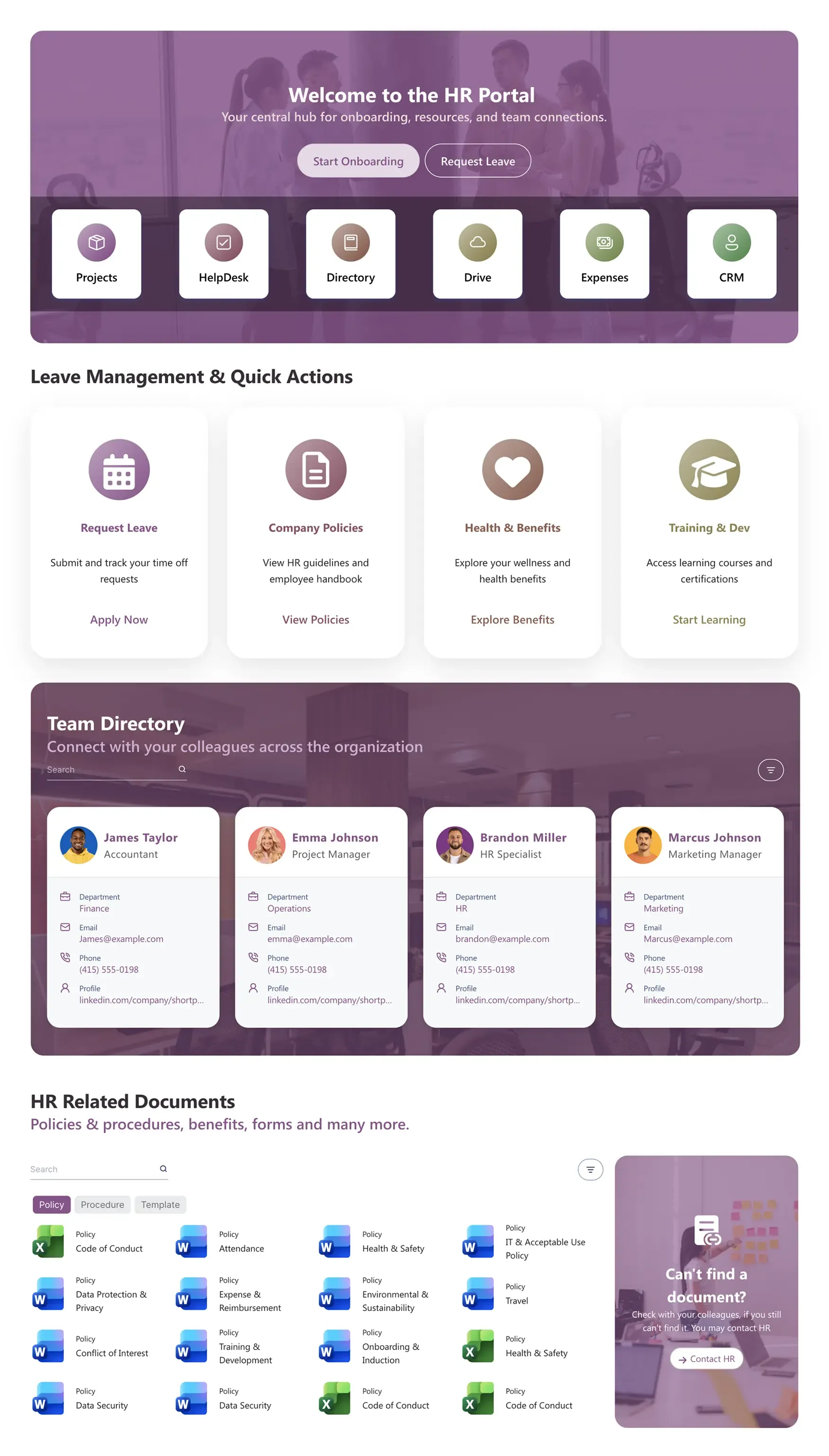
Built with: Text and Dual Button for the welcome header and two primary actions • Quick Links for the icon row • Icon Boxes for the quick-action cards • Person Cards for the searchable directory • File List for the filterable document center.
Template: HR Portal
2. The searchable resource hub
Some HR sections need to serve several kinds of document at once. This pattern splits policies, benefits, and onboarding materials into parallel category cards, each with its own search, so an employee goes straight to the right category instead of scanning one long list. It works well as a resources page sitting alongside HR forms, a directory, and an FAQ — every self-service function in one section. Use it as soon as your policy library passes roughly fifty documents, which is the point where a single flat list stops being usable.
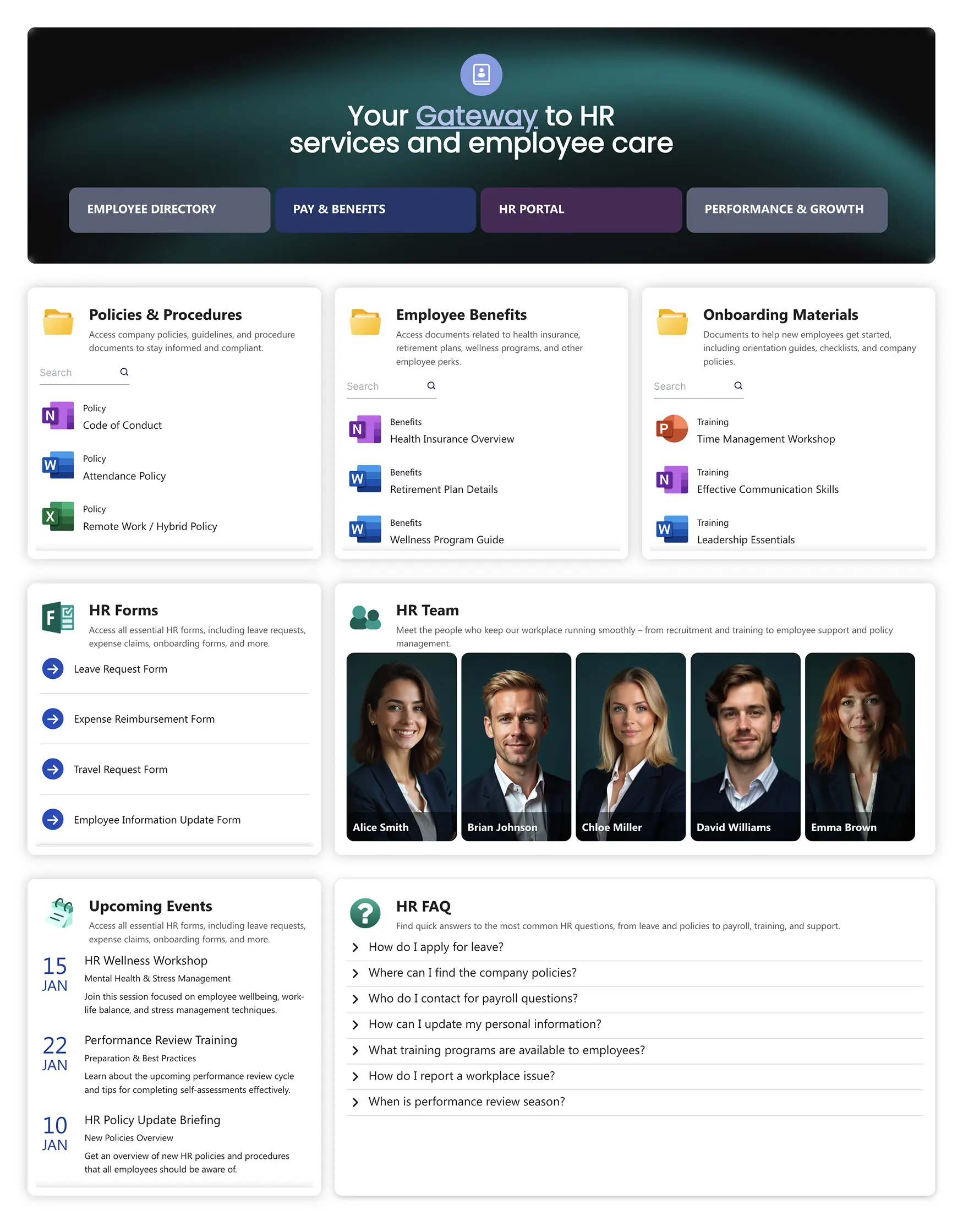
Built with: Tiles for the top category navigation • File List for each searchable document category, with a Search & Filter Toolbar for filtering and sorting • Icon List for the HR forms list • Image Titles for the HR team row • FAQs for the FAQ accordion.
Template: HR 12
3. The categorized announcements area
When there is more than one kind of update to share, this pattern gives each stream its own card — HR updates, staff requests, business trips. Employees scan headlines and open only what applies to them, instead of reading one undifferentiated feed. It pairs well with a dated events sidebar and a row of department statistics, which keeps news and day-to-day operations visually separate. The structural lesson generalizes: if two kinds of content have different audiences or different urgency, they need different containers.
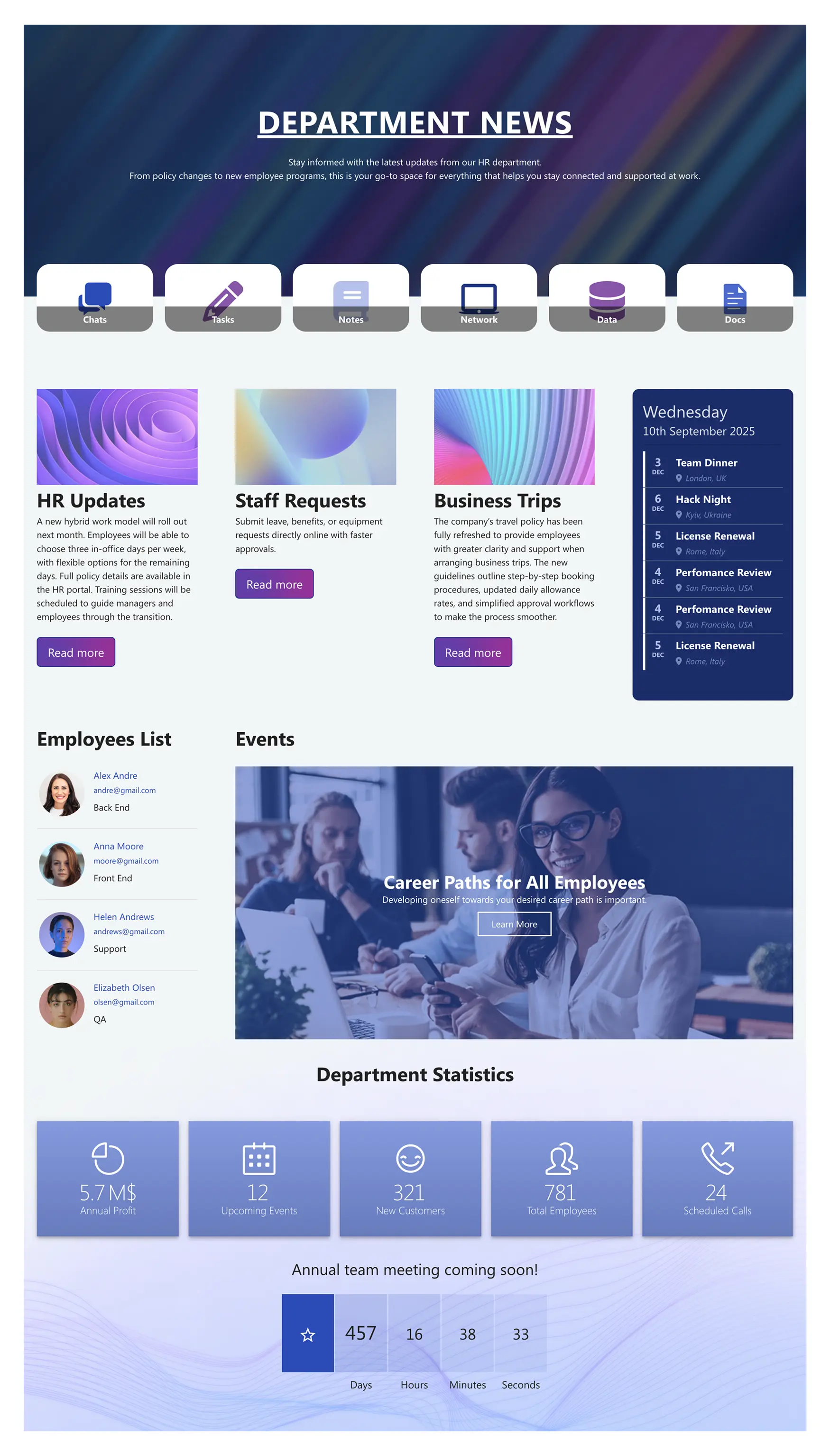
Built with: Image Boxes for the three categorized story cards • Events for the dated events sidebar • Image List for the employee list • Counter Boxes for department statistics • Countdown for any hard deadline, such as a benefits enrollment window.
Template: HR 7
4. The step-by-step journey
Not every HR section is a hub to browse — some need to walk someone through a process in order. This pattern builds a new-hire onboarding journey around a five-step roadmap covering paperwork, orientation, benefits, training, and a check-in, with each step expanding to show what to expect and what is needed. Around that spine sit the pieces a new hire needs along the way: a personalized welcome, essential quick links, onboarding documents, a contact list for the onboarding team, and a company culture section.
This is the model for any HR content with a sequence, not just onboarding. A performance review cycle, a leave request process, or benefits enrollment can all use the same step-by-step structure. If you are focused specifically on this section, our SharePoint onboarding templates go deeper on it.
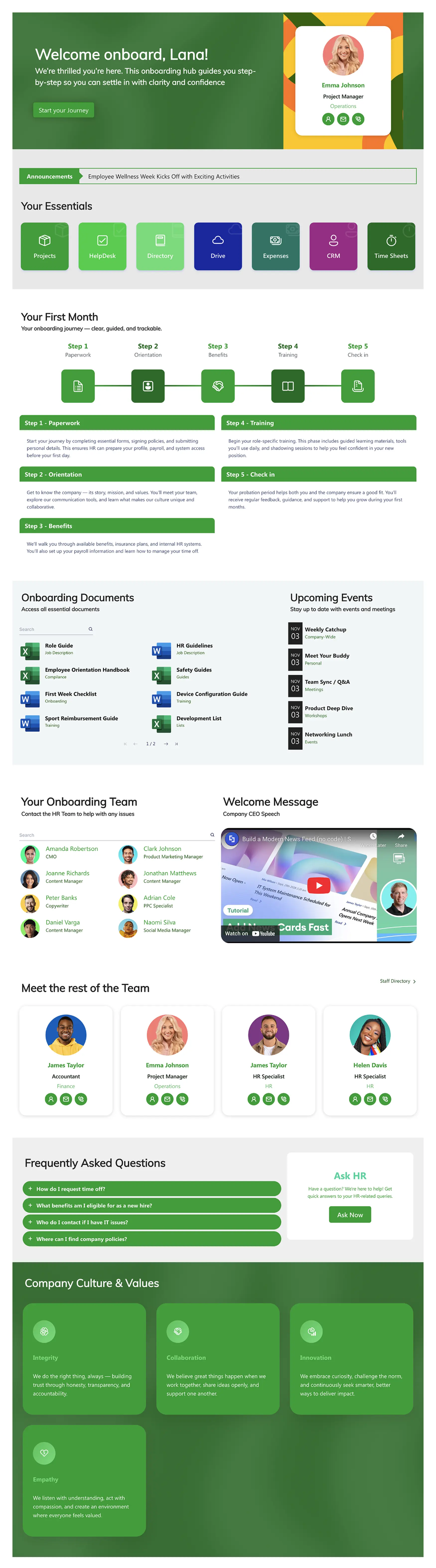
Built with: Text and Button for the personalized welcome header • Steps for the five-stage roadmap • Quick Links for the essentials row • File List for onboarding documents • FAQs for the searchable FAQ accordion.
Template: Onboarding Essentials
Most real HR sites combine all four: a top-tasks homepage, a resource hub for policies and benefits, a categorized news area, and a step-by-step onboarding journey. If you would rather start from a finished design than assemble the patterns yourself, the SharePoint templates library covers all four, and the HR-specific designs are the closest starting point.
Explore the template library →How to build your HR site structure with AI
Planning the structure is the part that needs your judgment. Assembling it is the part that used to eat a week. Two AI capabilities close most of that gap.
Generating the page from your plan
ShortPoint AI Designer generates a complete SharePoint page from a written description. Because your plan is already a list of sections and behaviors, it converts almost directly into a prompt. AI Designer reads your Theme Builder settings, so the result comes out on brand without manual styling, and it can build interactive behavior — search, filtering, sorting, tabs — into elements as it goes.
Here is how the patterns above translate into prompts:
Top-tasks homepage
Build an HR homepage with a welcome hero and two buttons for Start Onboarding and Request Leave, a quick links row for payroll, benefits and the help desk, four quick-action cards, a searchable team directory, and a filterable HR document library.
Onboarding journey
Create a new-hire onboarding page with a five-step roadmap for paperwork, orientation, benefits enrollment, training and a 30-day check-in, plus an onboarding document library, a contact list for the onboarding team, and a company culture section.
Policies section
Add a policies section with three searchable document categories — company policies, benefits documents, and onboarding forms — each with its own search and filter toolbar.
Treat the output as a first draft you refine, not a finished site. What AI cannot do is decide which sections your employees need. That still comes from your task list, which is why the planning work above comes first.
Wiring sections to live data by describing them
The second capability matters more for maintenance than for launch. ShortPoint Connect links design elements to live sources — SharePoint lists and libraries, shared calendars, and other Microsoft 365 data — so sections update themselves as the source changes. Normally you would pick a connection type, configure it, and map each field by hand. With AI Designer, you describe the connection in plain language instead and it handles the configuration behind the scenes:
Dynamic connection
Connect this file list to the HR Policies document library and display document name, last modified date, and owner, sorted by most recently modified.
That turns the most tedious part of building an HR site — wiring a dozen sections to a dozen sources — into a handful of sentences. For a wider view of what these tools do and do not cover, see our overview of AI for SharePoint .
Six HR SharePoint site structure mistakes to avoid
- Structuring around HR's org chart instead of employee tasks. Employees do not think in terms of Compensation & Benefits versus Talent Acquisition. They think "how much leave do I have left?" Internal team boundaries are the single most common source of navigation nobody can use.
- Putting everything on one page. Beyond a few hundred employees, one page tries to serve new hires, long-tenured staff, and managers simultaneously and serves none of them well. Split by audience and depth once any single section outgrows a screen or two.
- A policy library with no search or filter. A flat list of 200 documents is technically complete and practically useless. Any document collection past roughly fifty items needs search, filtering, and categories, or employees will keep emailing HR instead.
- Mirroring your document folder structure in navigation. How files are stored is an artifact of how they were uploaded, not how they are looked for. Navigation should follow employee intent, even when that means one document appears under two headings.
- Copying content in as static text. Pasting the holiday calendar or the benefits summary as flat text means someone has to remember to update it. They will not. Connect the section to the source instead, so the page reflects whatever the source currently says.
- Designing for desktop only. If you have frontline, warehouse, retail, or field staff, a meaningful share of your audience will only ever see this site on a phone. A layout that only works at 1440px wide excludes exactly the people least likely to have another way of reaching HR.
Design for maintenance and every device
Two planning decisions get skipped, and both sink the site months later.
First, ownership. Decide before launch who keeps each section current: who updates the news, who maintains the policy library, who refreshes onboarding content. An HR site last updated six months ago signals that it cannot be trusted, and employees stop checking it. Assign owners and a review cadence as part of the plan, not afterwards.
Ownership does not have to mean manual upkeep. Because ShortPoint Connect links sections directly to SharePoint lists and libraries, shared calendars, and other Microsoft apps, the content updates itself as the source changes. Point the events section at a shared calendar, the documents section at a library, the news section at a list, and whoever owns that source keeps the site current just by doing their normal job. It turns "someone has to remember to update this" into "this already reflects what is true," which is the difference between a site people trust and one they quietly abandon.
Second, access. Mobile layout and accessibility are structural decisions, not finishing touches. Plan for readable tap targets, fast loading, and keyboard-navigable menus from the start. Starting from a SharePoint template takes most of this off your plate, since templates are built mobile-first and the layout already adapts to phones and tablets without manual configuration.
Pre-build checklist
Before anyone opens a page builder, you should be able to tick all nine of these:
- Your employees' top 10 tasks are written down, sourced from real HR tickets
- Every task maps to exactly one section
- You have decided communication site versus team site, and why
- You know which sections launch now and which come later
- Homepage content and subpage content are separated on paper
- Every top task is reachable within two clicks
- Each section has a named owner and a review cadence
- Each section that can pull from a live source has that source identified
- You have checked the layout against a phone screen, not just a laptop
From plan to live site: how ShortPoint helps
Planning the structure is half the job. For the other half — actually building it — these are the tools designed to get you there without custom development:
- Templates Library — start from an expert-designed template instead of a blank page, including our HR SharePoint templates , then adapt it to the structure you planned.
- Page Builder — build the page visually, placing design elements instead of writing code.
- Design Elements — assemble almost any section, from homepages and policy pages to directories and FAQs, from pre-built no-code elements.
- ShortPoint Connect — keep the site current automatically by linking sections to live SharePoint lists, libraries, and other Microsoft apps.
- Theme Builder — apply your organization's colors, fonts, and logo across the whole site in a few clicks.
- AI Designer — describe the structure you planned and get a working, on-brand page back.
New to ShortPoint? Start a free 15-day trial , no credit card required, or book a walkthrough and we will look at your HR site plan with you.
Start your free 15-day trial →Frequently asked questions

Yvette Tunguia
Content Unit Manager, ShortPoint
Yvette Tunguia is Content Unit Manager at ShortPoint, where she writes about SharePoint intranet design, structure, and adoption. ShortPoint is used to design and brand SharePoint intranets across 350,000+ sites worldwide.
Ignite your vision. Install ShortPoint directly on your site, or play in sandbox mode. No credit card required.